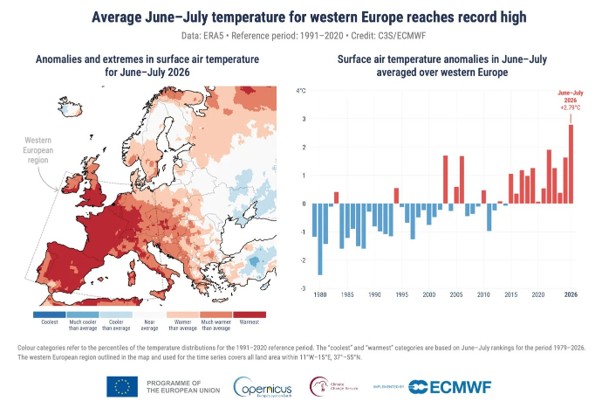
As I write this blog on a mid-August day in 2026, the sun is shining through a clear blue sky, as it has done much of the time since mid-June. A heatwave is underway for the 5th time this year, and every day since 18th June has reached at least the mid-20s °C. In records spanning more than 70 years, it’s been by far the warmest June-July on record.
That’s from a local perspective in the northeast corner of Dorset, but it’s been true across much of the southern half of the UK. An area that includes numerous commercial vineyards. Leveraging increasingly warm long-term weather, this industry has been gaining ground in recent decades.
You might instinctively expect that this astonishingly warm and sunny run of weather would be outstanding for the English vineyards, and that would be spot on if not for one thing: It’s hardly rained since early June.
Let’s consider the optimal weather for grapevines to flourish.
The Recipe for Wonderful Wines
In short, it’s about having the right sequence of weather patterns.
A perfect growing season consists of a cool but frost-light winter, followed by a showery spring with plenty of sunshine, then a summer of modestly wet spells separated by very warm and sunny weather. Importantly, abundant sunshine isn’t essential, it merely dictates whether the year produces deeper-flavoured, less acidic, sweeter wines (if very sunny), or more acidic ones which have a striking character that has gained recognition worldwide.
This optimum is essentially a typical English spring and summer but with temperatures dialled up a little. The optimal temperature range is 25-32°C. In the warmest areas of England, where vineyards tend to be located, nearly every summer reaches that from time to time. However, it’s often a struggle to see enough such days across the growing season.
Not this year! In fact, the only recent summers with even close to as many 25-32°C days are 2018 and 1995. Sunshine has also been record-high widely. But has this been overruled by the shortage of rain?
The Difficulty with Drought
From mid-June through to mid-August, many areas within the southern two-thirds of England have recorded little to no rainfall. There are no reliable records of a drier two-month period in this region. Numerous areas have gone longer without measurable rain than they did in the famous drought summer of 1976.
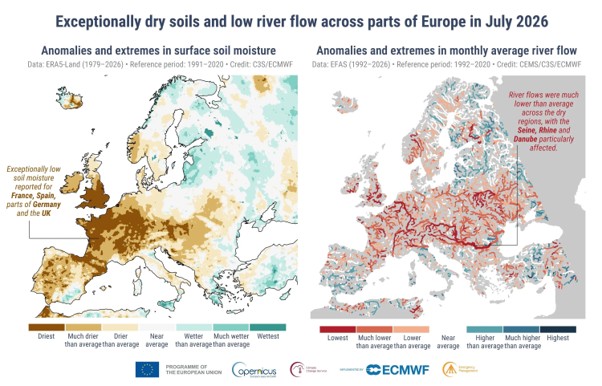
Unfortunately, this isn’t how you get ‘dry’ wines. Instead, the lack of rain means a shortage of water that the vines can pump into their grapes to plump them up. This can cause vines to slow or even halt growth as they strive to survive.
This effect can be moderated by thinning the crop to increase water supply to the remainder, but that still means some sacrifice of yield compared to a drought-free summer.
However, there is a twist to this tale when it comes to 2026.
Quick Gains
This year’s drought onset was quite far into the growing season, with the spring having been notably dry but not drought-inducing.
Since mid-June, it’s been so remarkably warm and sunny that grape growth has been unusually quick, allowing produce to reach good volume before the drought slowed things down.
As a result, vineyards are planning to harvest early. An early harvest, in late summer or early autumn, reduces the chance of too much rain and allows winemakers to pick at the optimum balance of sugar and acidity.
A guaranteed well-sized harvest? Almost…
What About Wildfire?
It goes without saying that grapevines aren’t going to be productive if they’ve been burned. What’s more, uniform crops are particularly vulnerable to fire spread.
In recent weeks, the hot dry weather has aided the spread of numerous wildfires in the UK, mainly in the south. There are several ongoing as I write this.
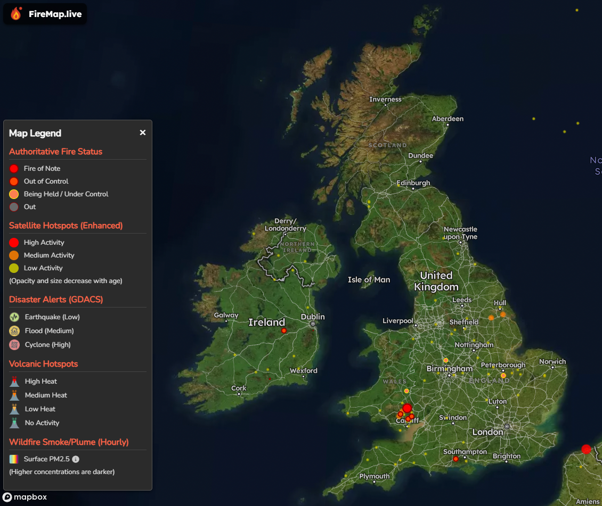
Fortunately, this threat can be countered by a carefully planned layout to the grapevines. By leaving wide gaps between some lines, they can form ‘fire breaks’. In fact, these can be valuable in combatting wildfires.
Still, a wildfire that reaches will still claim part of a vineyard’s harvest and heavy smoke from large fires nearby can taint the wines subsequently made. The exceptionally warm, dry, sunny weather since mid-June has escalated wildfire risk to the ‘extreme’ category. In many areas near-surface soil moisture has dropped to zero. This in turn means that shallow-rooted plants have become severely parched, hence much more flammable than usual.
So, this is a potential negative on this year’s harvest for any vineyards unlucky enough to find themselves in the path of a wildfire. Here’s hoping none meet that fate.
Friendly Trends?
Recent summers, now including this one, have largely been among the warmest on record in the UK. There’s no escaping the fact that summers are trending hotter.
Higher summer temperatures tend to mean higher potential alcohol and more concentrated, flavoursome wines.
Whether or not wines benefit from hotter summers comes down to the grape varieties involved. Based on recent trends, while traditional grapes such as chardonnay and pinot noir might benefit, those that have flourished in the UK before, such as Bacchus, might lose some of the acidity and aromatic elderflower character that has traditionally made them special.
We’ve also seen a clustering of dry summers this past half-decade, but it’s not clear whether this is part of a long-term trend, albeit many climate projections suggest it will be.
Regardless, as noted earlier, the effect of any droughts on vineyard produce depends greatly on timing. Establishing whether a meaningful relationship exists would require intensive research beyond the scope of this blog.
Helpful Harvest Weather
During the harvest, low rainfall is generally desired to limit the onset of mildew or other undesirable infections. While the typical British summer is hardly famed for being dry, it does tend to rain less often in August-September compared to October-November.
The 2026 Harvest Forecast
There are signs of a wetter final third to August, but little indication of very wet conditions. In fact, it might be a struggle for southern parts of the UK to see much drought relief. This could play into the hands of vineyards beginning their harvest.
September has been leaning toward drier than average in seasonal forecast modelling, something MetSwift’s Claros model has been indicating for some time. Currently, I see little reason to disagree with that. It wouldn’t be surprising to me if September brings another long dry spell or two. Again, encouraging for the vineyards.
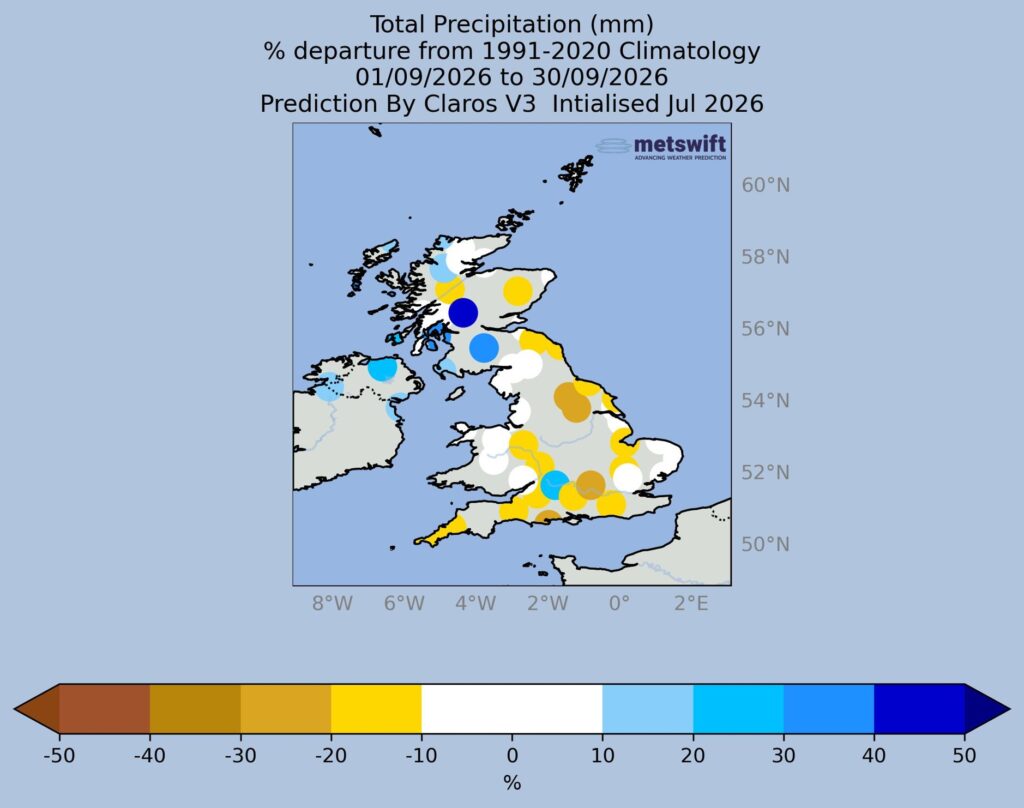
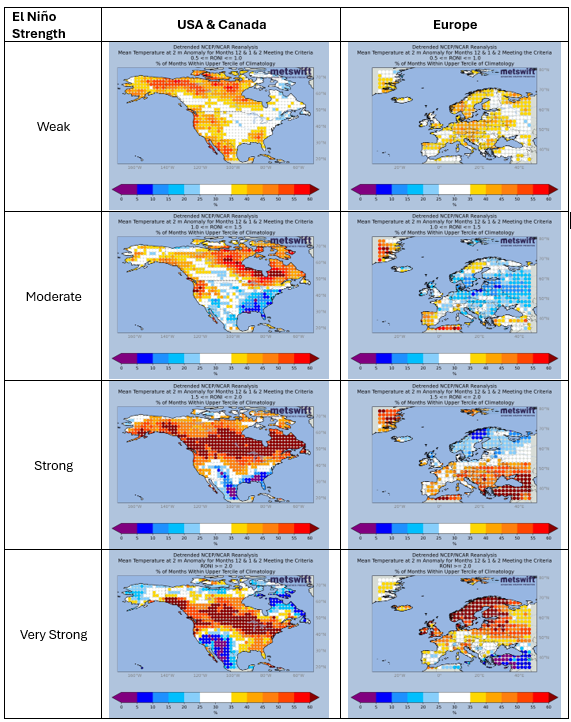
Later in the autumn, there are ominous signs in the forecast guidance. Heavily skewed by a record-strong El Niño event in the tropical Pacific, most seasonal modelling is strongly leaning toward wetter than average for October-November 2026 across all the UK and Ireland.
I feel that this might be overly presumptuous considering we’ll be uncharted territory – something I’ll be writing about soon. Claros concurs, suggesting more of a wetter west, drier east pattern for October (and to some degree November, not shown here).
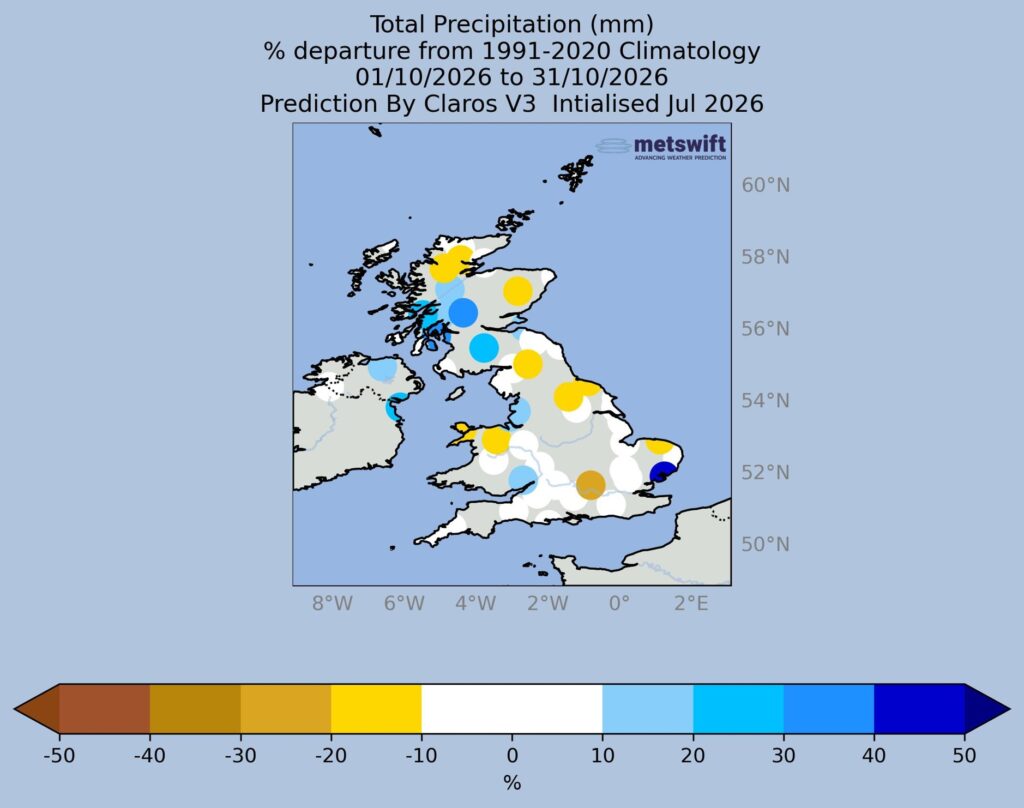
However, after a dry spring and very dry majority of summer in southern UK, it would be surprising and very alarming if autumn rainfall was below average overall. So, the vineyards may find themselves very thankful to have been able to harvest early.
Unusually Mediterranean Wine Character?
If the relationships laid out under “The Recipe for Wonderful Wines” bear fruit, English vineyards should produce more generously fruity wines than usual, with a rounder mouthfeel and perhaps slightly higher alcohol by volume, but potentially to the detriment of the traditionally successful Bacchus. Less distinctive than the UK has become known for.
In some ways they might not stand out as much in the global market, but I’m sure there will be some mighty fine wines!
James Peacock MSc
Head Meteorologist at MetSwift
Featured photo by David Köhler on Unsplash